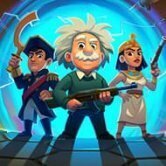
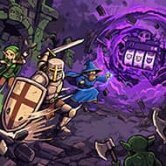
Gear Up Einstein! looks like a joke about history’s famous faces dragged into one squad, but it plays like a tight tactics puzzle where every fight is mostly decided before it starts. You position your heroes, pick their gear, and then watch the auto-battle resolve while you wince or cheer. The silly premise hides a real brain-teaser about placement and item synergy.
| Genre |
Strategic roguelite auto-battler |
| Players |
1 to 3, solo or co-op |
| Playable characters |
29 |
| Items |
Over 100 |
| Gadgets |
13 |
| Enemies |
35 |
| Difficulty levels |
5 |
Recruiting a Squad in Gear Up Einstein!
A time machine is how you recruit, and the roster reads like a dinner party that went wrong: Einstein, Tesla, Mozart, Jesus, Queen Elizabeth and more, 29 playable characters in all. Each hero carries perks inspired by the real person, so Jesus resurrects seven seconds after dying and Tesla fits the Scientist class. Early in the game you will lean on whoever has the clearest role, then reshape the squad around the perks you find.
Positioning matters more than beginners expect because the fight plays out without your input. Put fragile damage dealers behind sturdy heroes or the first clash ends the mission. Tactics fans who enjoy chess-style setup tend to love this phase, while impatient players find the waiting hard.
The squad perks are the hidden layer. Forty-eight of them add team-wide twists, and the strongest runs come from picking perks that reward the roster you already hold rather than chasing a favorite hero. A perk that boosts your Scientists is worthless if Tesla is your only one.
Gear Synergies and the Item Loop
More than 100 items and 13 gadgets turn each hero from a famous name into a weapon. Shops along the journey sell equipment, and every purchase shapes the fight that follows. The goal is the ridiculous combo, where two or three items feed each other until a single hero snowballs through the whole mission.
- Give damage items to the hero who is guaranteed to survive the first exchange.
- Keep a sturdy hero in front so your combo carrier gets time to act.
- Save gadgets for fights where positioning alone cannot solve the problem.
The classic beginner mistake is spreading gear evenly across the squad. It feels fair, but it dilutes every combo, and by the time harder missions arrive the team has no real carry. Min-maxers who commit early to one stacked hero usually get further.
Honestly, shop luck is the part players debate most. Like most auto-battlers, a bad run of offers can sink a plan, and some players feel the gear you are shown matters as much as the choices you make with it.
Divergence, Eras and Five Difficulty Levels
Every era carries its own combat modifiers, so a trip through Ancient Egypt, the Italian Renaissance or New York changes what works. A plan that crushed one era can stall in the next, which keeps you adjusting rather than repeating the same loadout. That is where the roguelite side shows up: each run asks you to adapt.
The Divergence system pushes this further by shuffling modifiers, enemies and gear across eras, so no two runs line up. With 35 enemies and 5 difficulty levels on offer, the late missions before the final stand against the monstrous invaders feel noticeably sharper than the opening ones.
The game is still in Early Access, and that shows in places. Players hoping for a huge amount of variety may notice repeats after enough runs, though more eras, characters, gadgets and enemies are planned as the game grows.
Co-op Roles and Where Gear Up Einstein! Frustrates
Up to three players can share a run, either on the same machine or across Steam and Itch.io through crossplay. Co-op groups usually settle into roles: one player anchors the front line with survivability gear, another stacks the damage combo, and the third supports with gadgets. The coordination is half the fun and half the argument.
The friction comes from sharing resources. Everyone wants the best item, and a group that cannot agree on who carries will waste gear on three half-built heroes. Social players enjoy that negotiation, while quieter players may prefer solo runs where every decision is theirs alone.
Frustrations are mostly the usual auto-battler ones: you cannot step in mid-fight, and a lost mission can feel decided before the first attack lands. The upside is that every loss points to a placement or gear choice you can fix on the next run.
- Can you play Gear Up Einstein! solo? Yes. The game supports one to three players, so you can lead a full squad of historical heroes alone while combat stays automatic. Solo runs make Divergence shifts and shop choices easier to read because nobody else is competing for gear.
- How many characters and items are there? The current roster has 29 playable characters, over 100 items, 13 gadgets and 48 squad perks. That is enough to try very different squads, from a Scientist-heavy team around Tesla to a Jesus resurrection gamble.
- What does Divergence change? Divergence shuffles combat modifiers, enemies and gear across eras. Instead of memorizing what each era throws at you, you have to read the modifiers on every mission and adjust your gear and placement.
Gear Up Einstein! rewards players who treat Tesla’s Scientist class, Jesus’s seven-second resurrection and a well-placed gadget as pieces of one puzzle. Learn which era modifiers punish your squad, keep your carry protected behind a sturdy hero, and the monstrous invaders at the end stop looking impossible.