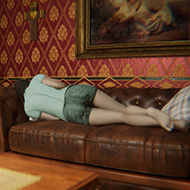
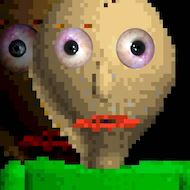
You walk through the front door after school, drop your bag by the stairs, and glance into the living room where she’s sitting in her usual chair. Something about the picture frame on the wall looks off, but you can’t say why yet. That small hesitation is the entire game of That’s Not My Mom!, and it never really lets go of you once it starts.
| Genre |
First-person psychological horror, anomaly-spotting |
| Perspective |
First-person, single house environment |
| Playtime |
40–60 minutes |
| Core Loop |
Return home, inspect the house, decide if the mother is real |
The Anomaly Loop in That’s Not My Mom!
Each day begins the same way: the boy comes home from school and has to walk the same short route through the house before reaching the living room. That repetition is deliberate. The game wants you to memorize where the couch cushions sit, how many picture frames hang in the hallway, and which direction the plant by the window is turned, because on a later day one of those details will be wrong. You’re never told what changed. You’re only told, eventually, whether you guessed correctly.
Early days keep the differences obvious — a duplicated chair, a missing photo, a light left on that was always off. This is the game teaching you how to look rather than what to look for. Once you’ve cleared the first few returns home, the anomalies stop announcing themselves. They hide in details you’d normally skim past, and that’s when the tension in That’s Not My Mom! actually starts to bite.
There’s no combat and no inventory to manage. The entire game is built around observation and a single decision each day: let her in, or don’t. That simplicity is part of what players argue about in comment sections — some find it refreshing that a horror game trusts you to just look, while others feel the lack of any other system makes a wrong guess feel arbitrary rather than earned.
Reading the Mother’s Behavior
By the time you reach the middle days, the game shifts its focus from the room to the woman sitting in it. Her posture, the pitch of her voice, the way she holds a conversation — all of it can drift slightly from what you established as normal on Day One. Some players describe this as the point where That’s Not My Mom! stops being a spot-the-difference exercise and starts feeling like an actual test of trust.
This is also where the impostor’s disguise starts to slip in ways that are genuinely unsettling rather than just visually wrong. A pause that lasts a beat too long. A smile that doesn’t quite reach the eyes. Players who lean into slower, careful playthroughs tend to catch these moments; players who rush the walk to the living room usually miss them entirely and pay for it on the next attempt.
One detail longtime players bring up often is that the game never punishes you for being cautious. Standing in the doorway a little longer, walking back to check a room again — none of it costs you anything mechanically, which quietly encourages the paranoid habit the whole game is built around.
What Happens When You Get It Wrong
Rejecting your real mother and letting in something wearing her face both carry consequences, though they don’t play out the same way. This is one of the more common questions players search for before starting: does a wrong guess end the run immediately? Not always. Some mistakes simply carry forward into the next day, coloring what you see and how much you can trust it, while others end things on the spot.
The uncertainty is intentional. It keeps you from treating each day as a puzzle with a clean reset button.
Later days introduce transformed versions of the impostor that abandon subtlety entirely, along with sequences where staying still is no longer an option. These moments are short but function as a release valve after the slow-burn inspection segments, and they mark a clear tonal shift that most players remember well after finishing.
Why the Ending Divides Players
The final day resolves the outbreak spreading through the city, but it does so quickly, which is where a lot of the discussion around That’s Not My Mom! tends to land. Given a playtime of well under an hour, some players feel the payoff arrives before the dread has fully built; others think the abrupt close fits a game about never getting a satisfying explanation for what’s wrong with the people around you.
How do you tell if it’s really your mom in That’s Not My Mom!?
You compare her current appearance and behavior against what you observed on previous days — posture, voice, small habits, and the state of the room around her. No single tell is guaranteed; the game expects you to weigh several small inconsistencies together before deciding.
Is there combat in That’s Not My Mom!?
No. The core game has no weapons or fighting systems. Your only tools are observation and the choice you make at the door each day, which is what keeps the pacing focused on tension rather than action.
How long does That’s Not My Mom! take to finish?
A full playthrough runs roughly 40 to 60 minutes, covering the sequence of days from the first ordinary return home to the final confrontation with the impostor.
What stays with you after finishing isn’t a jump scare, it’s the memory of standing in that hallway trying to remember if the picture frame was always crooked. That’s Not My Mom! turns a familiar house into something you can’t fully trust again, and the final day’s confrontation with the impostor is the moment that decision either pays off or doesn’t.