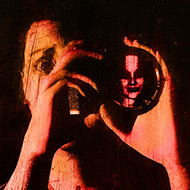
Shutter Story opens with a photo album that looks completely ordinary — until you tilt the exposure slider and something in the corner of the frame shifts where it shouldn’t. Your friend Eli is convinced his family’s house is haunted, his parents insist he’s imagining things, and the photos he hands you are the only evidence either way.
SpectralAware and the Investigation Loop in Shutter Story
The heart of the game is SpectralAware 2.1, an in-game photo and video analysis tool styled after an early-2000s operating system, complete with a Frutiger Aero interface that feels deliberately mundane against the material you’re actually looking at. You adjust exposure, contrast, color channels, and noise reduction on each image until an anomaly surfaces — a shape that doesn’t belong, a face where there shouldn’t be one, a shadow with the wrong proportions cast across a hallway that should be empty. Once you spot something, the manual asks you to sort it into categories like Apparitions, Simulacra, Strange Lights, or Demonic Entities, and the manual itself becomes a tool you’ll flip back to constantly once the anomalies stop being obvious.
Classification isn’t cosmetic. Getting it wrong influences later conversations, escalation events, and how aggressively the haunting behaves once you leave the desk. This is a game that punishes sloppy analysis in ways you don’t notice immediately — a misfiled Simulacra early on might mean a first-person sequence later plays out far more aggressively than it needed to. Players who treat the categorization step as a formality tend to get blindsided, since the game rarely announces that a mistake happened; it just quietly reroutes the story toward a harsher version of the next scene. Cautious players tend to double-check every borderline anomaly against the manual before committing, treating a wrong classification almost like a permanent mark against them, while more impulsive players push through quickly and accept whatever version of the haunting results.
Between analysis sessions, you leave the SpectralAware desk and explore Eli’s house in first-person, where the horror stops being confined to a photograph and starts happening around you directly. The tonal shift between the clinical, Frutiger Aero interface of the photo lab and the claustrophobic first-person house sections is one of the things community discussion keeps circling back to — it’s a deliberate contrast, and it works, largely because the game never lets you settle into either mode for too long before yanking you back into the other. That whiplash between a sterile desktop and a genuinely unsettling hallway is, according to players who’ve finished it, the detail that sticks with you longest after the credits roll.
Narrative Structure Across the Photo Album in Shutter Story
Over 80 photos and video clips make up the game’s evidence pool, and they trace a hidden, multi-generational narrative rather than a single isolated haunting confined to Eli’s immediate family. Early in the game, anomalies are subtle enough that you’ll second-guess your own eyes — a faint discoloration in a window that could just as easily be a lens flare as a Strange Light — and by the time you reach the later albums, the distortions are blatant, practically staring back at you, and the dread comes less from spotting them and more from knowing what they imply about Eli’s family history stretching back generations before he was even born.
Some players lean into slow, methodical scrubbing through every frame before moving on, essentially treating each photo like a “seek and find” puzzle where missing even one detail feels like leaving a thread unpulled. Others rush the analysis to get to the first-person house sections faster, chasing the more immediate scares over the investigative pacing, and community threads are split fairly evenly on which approach makes for the better first playthrough. Both approaches work, though the game clearly rewards patience — details you gloss over in the photo lab tend to resurface later as unexplained events in the house, meaning a rushed early album can leave you confused about why a specific room behaves the way it does two hours later.
The developers have cited Her Story and Kiyoshi Kurosawa’s Pulse as reference points, and that lineage shows in how little the game relies on telegraphed threats. Shutter Story isn’t interested in jump scares as its primary tool; it’s building dread through implication, half-glimpsed details, and the unsettling feeling that something in your own home might be watching, mirrored by what’s happening in Eli’s. Players frequently describe a specific moment — catching a video clip where a family member’s reflection in a window doesn’t match their pose in the room — as the point where the game stopped feeling like a puzzle and started feeling like a threat.
Not every part of that ambition lands cleanly for everyone. A common point of community criticism is that the classification system can feel punishing on a first playthrough, since the game doesn’t always clearly telegraph which category an ambiguous anomaly belongs to — leading to consequences some players feel are unfair before they’ve learned the manual’s internal logic well enough to predict it. It’s a fair complaint, and one the developers seem aware of, since later albums do a noticeably better job of hinting at category boundaries than the opening set does.
How long is the Shutter Story game?
The playable early section covers roughly the first 45 minutes and includes 15 photographs and 3 home videos, giving a solid sense of the SpectralAware workflow before the first-person house exploration ramps up into longer, more elaborate sequences in the full release.
Does Shutter Story include jump scares or is it more psychological horror?
It leans heavily toward psychological horror — implication, distortion, and slow-building dread rather than constant jump scares — though the first-person house sections do escalate into more direct, immediate terror as the multi-generational narrative deepens and Eli’s family history comes into focus.
What happens if you misclassify an anomaly in Shutter Story?
Incorrect classifications ripple forward into later conversations and escalation events, sometimes making the haunting in Eli’s house manifest more aggressively than it would have with an accurate read, which is part of why cautious players treat the manual as required reading rather than an optional reference.
Shutter Story earns its slow burn by making you complicit in every wrong guess, and once you’ve sat with Eli’s photo album long enough to recognize a real Apparition on sight, the fate resting in your hands stops feeling like a game mechanic and starts feeling personal.