What happens when the hunter hears a moo that sounds just a little too human? In Moo Who? that tiny mismatch is often all it takes to expose a player hiding in the herd, so every sound you push into your mic is a calculated risk.
| Genre |
Voice-mimicry hide-and-seek party game |
| Roles |
Animal players and hunters |
| Main input |
Your microphone |
| Best with |
A group of friends |
Hiding Among the Herd in Moo Who?
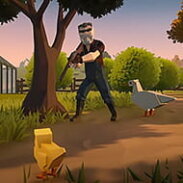
Animal players hide among NPC animals in a farmyard, wandering, pecking at objects and blending into the crowd while making animal sounds into their microphones. Hunters roam the same yard, listening and watching for anyone whose behavior or voice does not quite fit. It plays a lot like prop hunt, except your disguise depends on your throat as much as your movement.
The first round is usually pure chaos. Nobody expects to laugh that hard at a friend’s attempt to squawk like a chicken.
Party groups get the joke immediately. The game works best when everyone commits to the bit instead of trying to play it cool.
Sounding Like a Real Animal
Your voice is the main tool and the main danger. A convincing moo or squawk keeps you hidden, while a hesitant or exaggerated one gives you away in seconds. The trick is matching the rhythm of the NPC animals around you rather than performing constantly. Real animals in the yard do not make noise every second, so a player who never stops mooing stands out.
Beginners make sounds far too often. Silence is just as much a part of the disguise.
- Listen to the NPC animals for a moment before making any sound.
- Copy their timing, not just their noise.
- Avoid voices that slip into human words or laughter.
- Go quiet when a hunter wanders close.
Playing the Hunter
Hunters carry most of the tension. Their job is careful listening, comparing every sound against the NPCs and watching for animals that move with too much purpose. Rushing to accuse the first odd noise is the most common hunter mistake, because the yard is full of NPC sounds designed to throw you off.
Sharp listeners make the best hunters. A good ear beats fast reflexes here.
Competitive players often prefer this role, since a well-read accusation feels like solving a small puzzle. Patient hunters who wait for a second giveaway sound usually win more rounds.
Spectator Mode and the Fly Countdown
Getting caught does not mean sitting in silence. Eliminated players move into spectator mode with voice chat, where they can watch the rest of the round and comment on every questionable moo. A speaking-based fly countdown adds pressure for whoever is still hiding.
Spectators often become the loudest part of the session. Their commentary keeps the group laughing between rounds.
This keeps everyone involved even after an early elimination, which is important for a party game. Nobody spends long stretches just waiting for the next match.
Where Moo Who? Draws Criticism
The game has its detractors. Many reviewers claim that much of the art, menus and even mechanics look AI-made, and they see that as low effort. Others say the fun fades after the first couple of rounds, and some report bugs that disrupted matches.
Those complaints are common in community threads. Still, plenty of players call it hilarious with the right group.
Solo players tend to have the weakest time. The game is clearly designed for friends who can play off each other’s reactions.
Moo Who? Party Questions
How do you avoid getting caught as an animal?
Match both the sounds and the rhythm of the NPC animals around you. Avoid exaggerated or human-sounding noises, and go quiet whenever a hunter gets close. Moving naturally, like pecking at objects, helps your voice sell the disguise.
Is hiding in the herd fun solo?
It is much better with friends than alone. Most of the humor comes from group reactions in voice chat and spectator mode. Solo sessions tend to lose momentum quickly.
What happens after you are caught?
You join spectator mode with voice chat and can keep watching the round. You can comment on the remaining players while the fly countdown ticks on. It keeps eliminated players part of the fun.
Moo Who? rewards herds who moo with conviction but know when to stay silent, and hunters who wait for that second suspicious squawk before making the call while the spectators heckle from the sidelines.