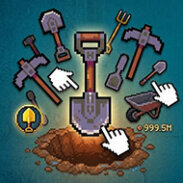
In Dirt Clicker you start with a single patch of dirt and nothing but your mouse button, which matters because every early click decides how quickly your first upgrade arrives and how soon the game starts earning for you instead of the other way around. Patience in the first minutes pays off for the rest of the session.
| Genre |
Incremental clicker |
| Main resource |
Dirt |
| Progression |
Upgrades that raise click power and passive income |
| Session style |
Short active bursts or long idle stretches |
Clicking the First Pile in Dirt Clicker
The core loop is as simple as incremental games get. You click the dirt to earn more dirt, spend that dirt on upgrades, and those upgrades either make each click worth more or start producing dirt on their own. The opening minutes are entirely manual, so the first purchase that generates income without clicking feels like a small victory. Everything after that is about speeding up the cycle.
Early progress feels slow on purpose. The pacing is built to make the first automation upgrade land with real weight.
Casual players who like watching a number climb will settle in fast here. There is no failure state, no timer and no penalty for stepping away, which makes it an easy tab to keep open between other tasks.
Reading Upgrade Costs Instead of Buying Blindly
Every upgrade gets more expensive each time you buy it, and that scaling is the heart of the strategy. The mistake almost every beginner makes is buying whatever is cheapest the moment they can afford it. That feels productive, but it often means pouring dirt into click upgrades long after passive income would have paid off better. Comparing how much each purchase actually adds against what it costs is the habit that separates a slow run from a fast one.
A simple rule works well. Once a click upgrade costs more than a few minutes of manual clicking, switch your focus to passive income.
Players who enjoy light math will find this comparison surprisingly satisfying. Spotting the moment when automation overtakes your own clicking is the first real decision the game asks you to make.
Active Clicking Versus Idle Growth
Two playstyles shape how a session feels. Most players drift from the first to the second:
Active play means clicking constantly to push early upgrades out faster. It matters most in the first stretch, when passive income is tiny and your finger is the only real engine of progress.
Idle play lets passive upgrades carry the load. Once they are strong enough, clicking becomes a bonus rather than a necessity, and the main loop turns into checking in, spending what has piled up and leaving again.
The Grind and the Autoclicker Argument in Dirt Clicker
The most common criticism is repetition. Once the upgrade pattern is clear, there is little new to discover, and some players lose interest when progress slows in the later stretch. Others enjoy that calm, predictable rhythm exactly because nothing surprising happens. Which camp you fall into usually becomes obvious within the first session.
Autoclickers are the other hot topic in clicker communities. Some players see them as a reasonable shortcut, others feel they remove the point of playing.
New players tend to wonder about the same things. Three questions come up again and again:
- How do you progress faster? Balance click upgrades against passive income upgrades and compare what each one adds for its cost. Shift toward passive income once click upgrades get expensive, since automation keeps earning dirt even when you stop clicking.
- Is clicking still useful later? It matters much less once passive upgrades take over. Active clicking is most valuable in the opening minutes, when every click is a noticeable share of your income.
- Should you use an autoclicker? It speeds things up but removes the hands-on feel that makes the early game satisfying. Many players click manually at the start and then let passive income handle the rest instead.
Dirt Clicker rewards players who turn that first patch of dirt into steady passive income, switching from click upgrades to automation at the right moment instead of wearing out the mouse button. Time the switch well, and the dirt keeps piling up even while you are away.