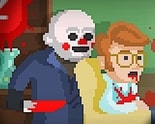
You flip a nursery light switch that shouldn’t matter, and the shadow crouched in the corner flips with it — one beat too slow, as if it forgot the light was supposed to change anything. That’s the moment The Happyhills Homicide stops feeling like a goofy odd-jobs game and starts feeling like it’s watching you back. You’re running a fledgling ghost-removal outfit, OVERCURSED Inc., and the first house calls are almost mundane: hang a protective charm here, scrub a satanic doodle off a bedroom wall there.
| Genre |
Horror-Comedy Point-and-Click Adventure |
| Platform |
Browser (HTML5) |
| Core Mechanic |
Environmental investigation and left/right-click interaction |
| Companion |
Rocky, a dog who can be commanded to follow or wait |
Founding OVERCURSED Inc. in The Happyhills Homicide
Each house call plays out in a cross-section view, the building sliced open like a dollhouse so every room stacks visibly on top of the next. Movement is mouse-driven, which sounds simple until you try to walk a hallway and instead send your character onto the wrong floor. Left-click picks things up or moves you toward them; right-click throws whatever’s in hand, a control nobody explains until a beast shows up later.
What trips up newcomers almost every time is that elevation mismatch. Your character’s position on screen doesn’t automatically line up with which floor they’re standing on, so first-timers often click a staircase that isn’t where they think it is. Once that clicks, navigating stops being a fight with the interface and becomes about the case itself.
Early cases teach the interaction language without saying so directly. The tools you’ll need later — throwing, swapping items, checking drawers twice — are handed to you quietly during these low-stakes calls, before you know you’ll need them. Replaying The Happyhills Homicide, you notice how deliberately those first houses set traps for future-you.
Rocky, Light Switches, and What Beginners Miss
Several rooms hide a small directional arrow near a light switch, and it’s not decoration — it nudges you toward the one interactive detail worth focusing on in a room full of red herrings. Skip past it and you can wander a house for minutes without realizing the plot-critical object was sitting three feet away. By House 4, the game has trained you to distrust every switch, since that’s the level where repeatedly toggling one is the only way past a specific standoff.
Rocky, the dog who tags along on jobs, is more than set dressing. Keep a bone on a string in your back pocket and he’ll follow you from room to room; lose it and he wanders off on his own, which occasionally matters for a scene. Watching him trot a half-step behind you is a genuinely warm detail in a game otherwise stacked with satanic scribbles and haunted furniture.
That warmth isn’t an accident. The game spends its early hours making Rocky feel indispensable specifically so the turn later lands as hard as it does. Players who’ve finished it talk about “the Rocky moment” the way other communities talk about a specific jump-scare — a shared reference point everyone recognizes without further explanation.
- Clicking too far ahead on a staircase instead of directly on the step
- Ignoring the directional arrow near switches and searching the wrong furniture
- Forgetting that right-click throws items instead of just examining them
Where The Happyhills Homicide Turns Personal
Once a genuine threat starts stalking the halls, the game shifts its systems without changing its interface. The beast is drawn toward food left in the kitchen, and baiting it there separates a controlled encounter from getting cornered with nothing to throw. Traps go in specific spots the game never explains outright — you read the beast’s patrol pattern and act on it.
Without spoiling the exact beat, something happens to Rocky partway through that recontextualizes everything before it. The tone doesn’t shift so much as snap, and The Happyhills Homicide stops being a comedy with horror garnish and becomes a story about someone with nothing left to lose. It’s one of the more discussed twists in browser-length horror games, partly because several well-known Let’s Play channels covered it — part of why the game holds a 4.6-out-of-5 audience rating from over 400 reviews.
It’s also the game’s most divisive choice. Some players think the gut-punch elevates the back half above a standard haunted-house romp; others feel it undercuts the earlier humor and wish there’d been a warning going in. Both reactions show up constantly in discussion threads, and neither side is wrong.
Proton Packs and the Final House Calls
Once the story pivots, so does your toolkit. A proton pack — yes, the reference is intentional — becomes your main tool for whatever’s left standing in the last stretch of houses. Combat stays simple: point, click, hold ground, use the environment the way the beast encounter already trained you to.
What changes is the margin for error; these houses punish wasted movement far less gently than House 1 did. First-time horror-adventure players slow way down here, second-guessing every shadow; speedrunners treat the same stretch as memorized click patterns.
The proton pack’s charge-up hum right before the last confrontation is a detail most players only register on a second run — the first time through, you’re too busy reacting to notice the game telegraphed it.
- A call comes in with a routine-sounding complaint
- You search the house, using switches and arrows as your main clues
- A complication appears, and you improvise with whatever’s in your inventory
How do you get Rocky to follow you between rooms?
Keep the bone on a string in your inventory and Rocky sticks close, trailing a step behind wherever you walk. Drop or lose it and he wanders off on his own, which can leave him out of position exactly when a scene needs him nearby.
What’s actually going on with the light switch puzzles?
Certain rooms mark a switch with a small directional arrow flagging it as the object worth focusing on. House 4 is the clearest example, where repeatedly toggling a switch is the only way to force a standoff to resolve.
Does something bad really happen to Rocky?
Yes, and it’s the pivot the entire back half is built around. It’s handled seriously rather than played for another joke, which is exactly why it split opinion among players expecting the lighter tone of the earlier house calls.
The Happyhills Homicide earns its reputation the way most good short horror games do: by teaching you its rules gently, letting you get comfortable, then spending that comfort all at once. Rocky’s bone on a string, the arrow-marked switches, and the proton pack waiting in the wings never read as filler once you’ve seen where the story goes.