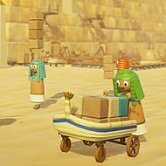
How They Built the Pyramids turns monument construction into a cooperative production challenge: start with Nile clay, make bricks, move them upward, and gradually organise a crew capable of building a huge structure. The central target is a pyramid described as 65 metres tall and made from 23,426 blocks across 26 layers. Manual labour is only the beginning, since better production and automation can turn a small operation into a more efficient system. The fun comes from coordinating work while leaving room for chaotic solutions when a brick or a teammate ends up in the wrong place.
| Genre |
Cooperative building and management |
| Team size |
One to eight players |
| Main material |
Bricks made from Nile clay |
| Construction target |
65 metres, 26 layers, 23,426 blocks |
Building the first layers in How They Built the Pyramids
The opening work is straightforward but repetitive: collect clay, turn it into bricks, and get each piece to the construction site. Early on, every trip matters because the crew has few ways to avoid manual carrying. Decide who makes bricks and who transports them instead of having everyone crowd around the same task. A group that divides work sensibly can establish a rhythm sooner, while solo players need to accept that production and delivery compete for the same attention.
Bricks are not just decorative pieces; their steady supply determines whether the build keeps moving. Improving quality and increasing production speed become more valuable as the structure grows. Keep an eye on where materials are piling up, because a fast brick-making process is not helpful if nobody can get the output to the pyramid. Players who like logistics will enjoy balancing supply and delivery, while those who prefer improvisation may focus on finding unusual ways to move blocks.
The scale is part of the joke as well as the challenge. A pyramid with 26 layers and 23,426 blocks gives the team a clear long-term target, but it also makes inefficient habits obvious. The repetitive hauling can feel grindy before automation becomes useful, and that is a fair criticism for players who want constant new mechanics. The payoff comes from watching a small operation become organised enough to handle a much larger workload.
Automation and Shabti in How They Built the Pyramids
As production expands, building and connecting automated systems can reduce the amount of work that has to be done by hand. Use automation to solve a bottleneck rather than adding machinery without a plan. If bricks are being produced faster than they can be delivered, improve transport; if the crew keeps waiting for material, strengthen the production side. This simple diagnosis keeps upgrades tied to an actual problem instead of turning the site into a collection of disconnected machines.
Shabti can help with routine work, giving the crew more room to manage the larger operation. Their usefulness depends on keeping the system organised and remembering that hired help is part of the workflow, not a magic fix for every bottleneck. A player who likes management can focus on a steady production line, while a more social player can coordinate tasks and let teammates handle different sections of the build.
The game also encourages unconventional movement. Bricks can be carried, tossed, or launched, and teammates can become part of the comedy when a risky shortcut goes wrong. That freedom is entertaining, but a chaotic solution may be less efficient than a predictable route when the team is trying to finish a large section. Agree on a reliable method for routine deliveries and save the experiments for moments when a mistake will not stall everyone.
- Establish a reliable clay-to-brick production route.
- Separate brick making from delivery when the crew is large enough.
- Use automation to address the current bottleneck.
- Bring in Shabti for routine tasks and keep their role clear.
- Experiment with tossing or launching bricks when the risk is manageable.
Teamwork and late construction in How They Built the Pyramids
Later layers make coordination more important because a single weak link can slow the whole chain. Keep communication practical: say what material is needed, where it should go, and which task is waiting. With up to eight players, assigning roles can prevent several people from repeating the same work while another station sits idle. Smaller groups may need to rotate responsibilities as the operation grows.
The experience can be funny precisely because its serious construction goal sits beside absurd ways to move people and bricks. That mix is a strength for groups that enjoy emergent mishaps, although players looking for a tightly controlled building simulation may find the physics and teamwork unpredictable. Once the main pyramid is complete, the broader building loop can continue through monuments and further production goals, so finishing the first structure is a milestone rather than necessarily the end of experimentation.
A short check-in after each construction milestone can prevent the crew from overproducing one resource while another part of the chain waits. Rebalancing the process as the pyramid grows is more effective than keeping the opening strategy unchanged.
How They Built the Pyramids questions players ask
How many bricks are needed for the pyramid?
The stated construction target is 23,426 blocks arranged across 26 layers, with the pyramid reaching 65 metres. Organising production and transport matters because making bricks quickly does not help if the crew cannot move them to the correct place.
What is the best way to automate brick production?
First identify the bottleneck: a shortage of bricks points to production, while piles of unused bricks point to delivery. Connect automation to that specific problem and check whether the flow improves before expanding the system further.
What do Shabti do in How They Built the Pyramids?
Shabti are helpers that can take on routine work as the operation grows. They are most useful when the team has a clear process and can focus on planning, transport, and construction instead of trying to solve every small task manually.
How They Built the Pyramids is at its best when Nile clay, brick production, Shabti, and teamwork form one dependable chain. Reaching the 26th layer takes more than carrying blocks quickly; it asks the crew to build a process that can keep supplying the structure even when the job turns chaotic.