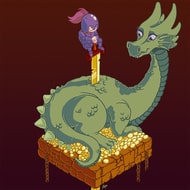
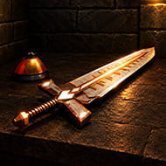
You lift the hammer over a glowing blade, watch it climb to +9, and realize the next strike decides whether you pay the dragon or hand over scrap. That single swing is ForgeTax in miniature: a dark first-person roguelite where every hit is a bet, every sword doubles as a currency, and a bell on the counter tells the dragon you are ready to settle up. The contract runs 21 days, and nobody who owes the dragon gets a day off.
| Genre |
First-person roguelite |
| Contract length |
21 days |
| Core loop |
Heat, strike, pay tribute |
| Currency |
Swords and G |
| Platform |
PC |
A Day at the Anvil: Heat, Strike, Ring the Bell
Every day starts the same way. You take a sword from your supply, heat it, bring it to the anvil and start swinging. Each successful strike pushes the sword’s value higher, but the chance of a Break climbs with it, so the real question is never how to hit but when to stop. Once you are satisfied, you lay your swords on the counter and ring the bell to pay the tribute, and meeting the requirement earns another round at the anvil.
Beginners make the same mistake in the first hour: they treat every sword like a lottery ticket and keep swinging until it shatters. The game quietly teaches the opposite lesson through its achievements, since paying at least three times the tribute requirement is rewarded as Keep the Change, while breaking ten swords in one run earns All Thumbs. Swords are also your shop currency, so every needless break costs you twice.
- Pick one Day 1 gift relic from the three offered, because the others vanish.
- Heat a sword and strike until the value clears the tribute with a margin.
- Ring the bell, then spend leftover swords in the relic shop from Day 2.
Players who love running numbers will enjoy working out the margin on every sword before ringing the bell, since the tribute requirement is the one number you can plan around.
How Tickets and Frenzy Decide Every Strike in ForgeTax
Under the hood, each strike draws from a pool of tickets, and every ticket is one of five results: Break, Damage, Hold, Success or Great. Success and Great raise the sword’s level, Hold keeps things steady, Damage knocks the level back, and Break destroys the sword outright. Relics work by adding, removing or converting tickets, which is why a relic that adds a single Great ticket can change an entire run. Reading the ticket counts on the panel before each swing is what separates informed risk from superstition.
Frenzy is the other half of the loop. Strikes build up Frenzy charge, and once the charge is full you enter Frenzy, a short window where the sword is shielded from shattering. Almost every player triggers it in the first run, and relics such as Chained Hourglass and Ember Locket exist purely to feed the charge. By Day 7 Possessed Bellows can appear in the shop, and Undying Wick follows on Day 8, at which point Frenzy stops being a bonus and becomes the plan.
This is where the divisive part shows. The ticket draw is random, and some runs simply hand you three Breaks in a row. Reception among players is mixed, and the argument is almost always about how much of a run is skill and how much is luck.
Day 1 Gift Relics and Early Shop Picks
On Day 1 you are offered three relics from a pool of eight, you keep one, and the other two vanish with no reroll. The pool includes Bent Nail for four extra Success tickets, Black Knot for a 10% cut to Break chance, Inspection Stamp for money, Sealing Stone for Hold builds, Cracked Splice, Sealed Heart, Leather Loop and Lucky Coal. Black Knot is the safe pick for new players, since a flat reduction to Break chance helps every sword you ever forge.
From Day 2 the relic shop offers three paid relics each day, priced in swords rather than G. Early picks like Charcoal Pouch and Iron Signet cost one sword each, and Worn Voucher, a two-sword relic from Day 3, grants a shop reroll every round when you are hunting for a specific piece. Spending swords on relics means fewer swords for tribute, so every purchase is a small gamble of its own.
Cautious players will usually take Black Knot on Day 1 and add Iron Hoop on Day 3 to stack Break protection before the tribute grows.
Relic Builds That Carry a Run in ForgeTax
Relics are strongest when they feed each other, and the community talks about builds the way other roguelite fans talk about archetypes. A relic that looks weak alone can become the backbone of a run once a second one joins it. These are the families players build around:
- Hold builds: Sealing Stone, Patient Weight, Cold Teacup and King’s Empty Cup turn quiet results into value.
- Great builds: Lucky Coal, Golden Nail and Oracle Die stack Great tickets for big level jumps.
- Frenzy builds: Chained Hourglass, Ember Locket and Perfect Mana Core keep the charge rolling.
- Economy builds: Inspection Stamp, Cracked Bell and Dragon Signet turn every strike into more value.
- Survival builds: Black Knot, Dragonscale Tongs and Phoenix Ash keep swords alive.
Some relics reward failure instead of avoiding it. Undertaker’s Chalice offers 30% of a broken sword’s peak value as scrap tribute, Ash Sieve pays 500 G for every break, and Grudge Nail banks Great tickets equal to the broken sword’s level. Players who enjoy risky experiments will build around those, treating Break as an income stream rather than a loss.
The biggest relics wait deep in the contract. Seal of Twins gives each surviving strike a 2% chance to duplicate the sword, and Sickle and Hammer resets every outcome to five tickets, which can rewrite your whole strategy. Lifetime Contract arrives on Day 10 for five swords, starting issued swords at +7 with no heating needed.
When the Dragon’s Rage Rises Late in the Contract
Fall short on a tribute and something beyond the bars loses patience. The dragon’s Rage climbs with every failure, and the last Rage stage is where runs are won or lost. Mourning Knot is built for that nightmare, adding a permanent Great ticket for each failed tribute, while Dragon’s Pardon prevents death once and lowers Rage by one before it vanishes.
Once Day 5 arrives, Sealed Rebate trims the tribute requirement by 10% and Tax Tally gives a relic shop credit for every full payment. Later, Royal Change carries 30% of excess tribute into the next requirement, and Pocket Hearth adds 20 G of base value per full payment made this run. A steady payer snowballs, while a gambler swings between feast and famine.
The achievement One Last Chance rewards paying tribute in full at the last Rage stage, and roughly 70% of players have earned it, which suggests the final stretch is tense rather than impossible. Even so, expect a few contracts that end early while you learn which relics suit your hands.
ForgeTax rewards the player who knows when to put the hammer down, and the best runs are built on small decisions: which Day 1 gift to keep, when to ring the bell, and whether Dragon’s Pardon is worth four swords. Take a Black Knot into your first contract, learn how Frenzy charges, and let the dragon’s Rage teach you the rest.