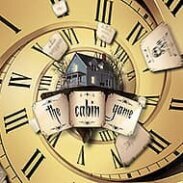
In The Cabin Game you start seated at a round table in the Dining Room with a hand of cards, and that matters because every card you play reshapes the building around you. Up to four players share one cabin, one clock, and one goal: work out which room is the exit before the monster pawn catches up.
| Genre |
Horror card play with first-person clue hunting |
| Players |
1 to 4, solo or co-op |
| Platform |
PC (Windows) |
| Status |
Early Access |
| Core loop |
Play cards at the table, then stand up and search the rooms you built |
| Goal |
Identify the exit room and escape before the clock runs out |
The Round Table and the Clock Track in The Cabin Game
You sit down at the round table to play cards, then stand up to walk the rooms you have built. Many first runs skip the in-game tips on the M key, which is a mistake, because the sit-then-stand loop is the part new players fumble most. Every card you play moves the clock track at the center of the table.
The table clock is both a timer and a sound-design choice, and it is loud. If it drowns out footsteps or events, the settings menu has a separate clock slider.
Early in the game the Dining Room is your only space, and everything else grows from there. The monster pawn creeps along the same clock track you are trying to beat, so slow turns have a price.
Room Cards and the Cabin You Build Yourself
The cabin has no fixed map. Room cards let players lay out cellars, living rooms, kitchens, and hallways as the run goes on, and the layout changes every session. That variety is the signature mechanic, and it is also where the first costly mistakes happen.
Beginners tend to snap rooms wherever they fit, then discover that an early choice has locked the group out of the exit later. Doors have to connect, hallways should loop, and late events can trap a table that built nothing but dead ends.
A few habits keep the layout healthy:
- Check door connections before you play a room card
- Prefer loops to dead ends when you place hallways
- Say your plan out loud before anyone snaps a room, since every play changes the cabin for everyone
Investigation Cards and Object-Dependent Clues
Clues hide in the rooms you place, but they only reveal themselves when the right conditions are met. Investigation cards log whether something is present or absent, and the clues depend on objects, with the grandfather clock as the example players point to most. The right card at the right moment matters more than searching every drawer.
That is why the clue notebook is the most valuable tool at the table. Write down the room, the object, and the card you played, and keep one shared log in co-op so partners are not guessing. Puzzle fans will love the logic, while players who want pure horror may find the note-taking slows the fear.
A third clue that never appears is a known frustration in multiplayer, since a held Traitor card can block it after the Cabin Carnage update. Ask the table before waiting forever.
Lifesaver, Progress, and Time-Skip Cards
The deck splits into room, event, investigation, lifesaver, progress, and time-skip cards, and the community priority is simple. Investigation and rooms come first, lifesavers next, events you already understand after that, and time-skips last.
Lifesaver and progress cards both shove the monster pawn back along the clock track, which buys turns when the table is losing. Time-skips do the opposite by jumping the clock forward, so a pile of them in a solo hand can end a run before anyone finds a clue.
Luck is the honest weak spot. Cards are shuffled randomly every run, and bad Lucky Clovers draws can still sink a careful table, which some players love as chaos and others call unfair.
Monsters in The Cabin Game: Attic Stalker, Neighbour, and More
Roughly a dozen random events can interrupt a run, and skipping the survive events is the fastest way to end one. Some are loud, like the Neighbour, whose event can darken the room and has drawn crash reports in Early Access. Others are quiet, like Cutting Corner, where you wait until the man in the corner turns before rushing the doorway.
Hallway Gaunt
A thin figure walks a lamp-lit corridor beside Welcome to Reality graffiti. Kiting it around the loop you built is the usual answer.
Attic Stalker
The Attic stalker is the monster most tables learn to fear first, since it can end a run if survive events are ignored. Players often confuse it with the toy-box scene, which is actually a separate child’s-room event.
Co-op Habits and Difficulty From Weenie to WTF
Pick a difficulty before the first deal. Weenie teaches the loop, while WTF punishes every careless snap and skipped survive event, so first-time lobbies belong at the gentler end.
Candy comes from completing runs and surviving events, and it spends at the Boo Factory on cosmetics, masks, and lobby pets. Nothing there changes how the cards play, so there is no reason to grief a learning run to farm it.
Hosting trouble is usually a version mismatch. If a friend cannot start their turn, verify files, update, and rejoin on the same patch; the failed-to-join message that appeared in Early Access was a false alarm that has since been fixed.
Quick Answers Before You Deal In
- How do you escape the cabin? Play cards to place rooms, gather clues until the evidence points to one exit room, and reach it before the monster pawn and the clock catch up. Survive events along the way, because skipping them is how most runs end.
- Can you play solo or only in co-op? Both work, with one to four players.
- Are there codes for The Cabin Game? There are no cosmetic redeem codes. The join codes you see are lobby invites only, and the candy you earn from runs is what you spend at the Boo Factory.
The Cabin Game is at its best when the whole table argues over one hand of cards, because a single misplaced room or an early time-skip can turn the Attic stalker from a story into a problem. Keep the clue notebook open, watch the clock track, and remember that the exit room is the only card that matters.