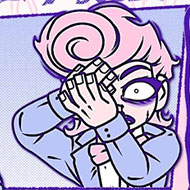
In It Reeks of Rot : Spring you begin with spring arriving outside while the promise of a pleasant season already feels wrong. The story combines visual-novel presentation with survival and psychological-horror elements, and the first demo focuses on a short stretch of time rather than a complete seasonal arc. Demyan is one of the named characters shaping that early section, while the planned structure places different love interests across a reverse seasonal sequence.
It Reeks of Rot : Spring and Day One
The opening day is deliberately compact, but the writing asks you to pay attention to conversations and behavior rather than rush toward conventional game objectives. The survival tag matters because the situation is not presented as a simple romance route; danger and discomfort are built into the way scenes unfold. Choices and observations therefore carry more weight than a traditional visual novel menu might suggest.
Demyan is especially noticeable because the developer has already discussed changing how often Demyan punches the player during Day One. That detail gives the demo a very specific physical tension that is easy to miss if you only think of the project as a romance story. The player is not simply choosing dialogue responses; the scene can become threatening through direct interaction.
Players who follow indie horror discussions often use terms such as yandere and psychological horror when describing the tone. The seasonal structure adds another layer because the love interests are associated with different parts of the planned year rather than all being introduced as interchangeable route options.
It Reeks of Rot : Spring Characters and Seasons
The developer has described a four-season progression running Spring, Winter, Autumn, and Summer, which is deliberately the reverse of the literal seasonal rotation. That structure gives the title a strong organizing idea even though the current demo does not contain the full year. Players who enjoy route analysis will likely pay attention to how the spring material foreshadows later relationships.
Day Two is still being developed, and Day One has also been receiving changes. That means the current demo should be read as a moving slice of the project rather than a fixed representation of every mechanic that will eventually appear. The writing is already detailed enough to encourage analysis, but some scenes and pacing are still subject to revision.
The most useful beginner approach is to treat dialogue as evidence. Small statements, reactions, and physical details can establish how a character behaves before the story explicitly explains why. That makes the visual-novel format closer to investigation than simple choice selection.
It Reeks of Rot : Spring Survival Pressure
The survival side is not built around a large inventory or conventional combat loop in the available demo. Instead, tension comes from what happens during encounters and from the uncertainty around character intentions. Once Demyan appears in a scene, the player can no longer assume that a conversation will remain purely conversational.
One detail that stands out from the current material is the use of physical violence as part of the characterization. The developer has specifically mentioned reducing the number of punches Demyan delivers in Day One, which also suggests that the balance of those scenes is still being tuned.
That is also the most obvious point of debate. Some players are drawn to the uncomfortable mixture of romance, violence, and psychological horror, while others may find the early demo too confrontational for a romance-focused visual novel. The project clearly chooses discomfort as part of its tone rather than hiding the darker material.
It Reeks of Rot : Spring Demo Structure
The current demo is short, and that limitation shapes how it should be played. Rather than expecting a complete route, look for recurring details, character behavior, and clues that can be interpreted against later updates. The writing itself is part of the puzzle, especially because the developer has said that people are already analyzing the demo’s text even when individual writings do not directly alter the narrative.
Players who enjoy theorycrafting can therefore get more from the demo by comparing scenes and character behavior instead of only looking for an immediate ending. Players who prefer fast gameplay may find the pace slower because the project deliberately gives conversations room to establish unease.
The reverse seasonal structure also creates a useful expectation: Spring is not necessarily the beginning of the entire emotional chronology. The planned order makes the title’s seasonal labels part of the mystery rather than a simple calendar marker.
What is It Reeks of Rot : Spring?
It Reeks of Rot : Spring is a visual novel with survival, romance, and psychological-horror elements. The current release is a short demo centered on its spring material, with Day Two still in development.
Who is Demyan in It Reeks of Rot : Spring?
Demyan is a named character in the spring material and is associated with physically threatening interactions in Day One. The developer has discussed reducing how often Demyan punches the player, making those encounters one of the clearest pieces of the demo’s current tension.
How does the seasonal structure work?
The planned love-interest structure runs Spring, Winter, Autumn, and Summer, which is the reverse of the ordinary seasonal cycle. The current Spring demo therefore represents only part of the intended structure rather than a complete four-season story.
It Reeks of Rot : Spring stands out through the uneasy combination of Demyan, seasonal romance, and survival-horror pressure. Even before the later seasons are complete, the Spring material establishes a world where a conversation can become physically dangerous and where the reverse calendar order encourages players to look for meaning beyond the current day.