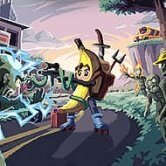
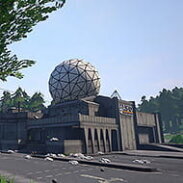
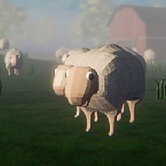
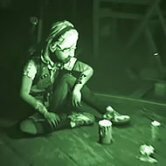
The first thing Big Walk takes away from you is certainty about where your friends are. You set off across a wide landscape with a group, someone wanders over a hill, and suddenly their voice is fading into the distance. That small moment explains the whole design: House House, the studio behind Untitled Goose Game, built a co-op adventure where talking, pointing and staying together matter as much as solving any puzzle.
| Developer |
House House |
| Publisher |
Panic |
| Players |
2 to 12 |
| Release |
August 4, 2026 |
| Platforms |
PC, Mac, PlayStation 5, Switch 2 |
Talking and Walking in Big Walk
Proximity voice chat is the core mechanic. Voices fade with distance, echo down corridors, get muffled through walls and crackle through walkie-talkies, so where you stand changes how well your group can hear you.
The world is open, and you choose your own pace through it. Challenges and puzzles are spread across the map, and many can only be solved when players split up, describe what they see and coordinate a plan.
At certain moments characters lose their voice entirely. When that happens the group has to fall back on gestures, objects and improvised signals, which is where a lot of the funniest moments come from.
Tools, Toys and Questionable Objects
Big Walk hands players a strange kit. Walkie-talkies, laser pointers, binoculars, megaphones, flares, whiteboards, cowbells and even a big golden head all help with communication in different ways.
Some tools are practical, like a laser pointer to show a path. Others are mostly for mischief, and the developers openly encourage stealing a friend’s binoculars and kicking them into the ocean.
That mix is deliberate. The game treats hanging out, watching a sunset or messing with each other as just as valid as pushing toward the next goal.
Small Groups Versus Big Crowds
With two players, Big Walk is a focused co-op experience where every clue is shared directly. With a full group of twelve it becomes louder and messier, and keeping everyone on the same page turns into its own challenge.
Critics praised it heavily at launch, and Steam reviews were strongly positive in the first days. The main complaint is simple: you need friends to play, because there is no solo mode.
The adventure is hand-crafted with an ending rather than an endless service game, and it has two different endings for groups to reach.
Why Communication Becomes the Real Puzzle
Many co-op games give everyone the same information on screen. Big Walk deliberately splits it up, so one player might see a landmark while another stands next to the switch that matters, and the only bridge between them is talking.
That design makes ordinary skills feel heroic. Describing a strange rock formation clearly, pointing a laser at the right ledge or ringing a cowbell at the right moment can be the difference between a solved puzzle and twenty minutes of wandering.
It also creates great stories. Groups remember the time someone lost their voice and had to draw directions on a whiteboard far more than any single puzzle, and that is the kind of moment the game is built to produce.
What Players Ask About Big Walk
- How many people can play Big Walk? It supports between 2 and 12 players. Small groups get a focused puzzle trip, while large groups get louder, more chaotic sessions.
- Can you play it alone? No, it requires at least two players connected over the internet. Communication between real people is the core of the design.
- Who made the game? House House from Melbourne developed it, and Panic published it. The studio previously made Untitled Goose Game.
Big Walk turns a walk with friends into a puzzle about communication, complete with fading voices, walkie-talkies and a very questionable golden head. Gather a group, stay within earshot and the game rewards every conversation along the way.