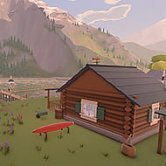
Why would Grandpa leave you a cabin on the shore of Hollow Creek Reservoir and then ask you not to drain it? Don’t Drain The Lake is built around that question, and the only way to answer it is to pick up the bucket and do the one thing the note forbids. The bank wants its money by the first frost, which gives you a reason to keep going.
Why Grandpa’s Rule Hangs Over Every Bucket in Don’t Drain The Lake
The setup is a small contradiction that drives the whole game. The mill downstream pays a dollar for every cubic metre you send over the dam, the reservoir holds half a million of them, and Grandpa’s note sits on the table asking you to leave the water alone. Money and conscience point in opposite directions, and the game lets you feel both.
Out in the middle of the lake stands a bell tower, rising from the water where no bell tower should be. Early in the game it is a shape in the fog, and a lookout on the hillside with Grandpa’s brass telescope lets you get close enough to count the slates on its roof. That is usually when players start wondering what the valley is hiding.
The story arrives in fragments, not in cutscenes. Grandpa’s clock still keeps time, his radio still plays with static that worsens the further you walk, and his notes in bottles sit a little deeper on the lakebed each time. Lore hunters will want to drain as far as they can just to read the next one.
Pumps, Manifolds and a Notch in the Dam
The draining side of the game is a gentle hydraulic puzzle, and it grows out of the bucket step by step. Pumps lift water over the dam, and the lower the lake sits, the harder each pump has to work. That one rule explains why a layout that felt great at full level starts to struggle later.
Bucket. The first tool and the slowest. Scooping by hand is satisfying for a few minutes, but half a million cubic metres will not move this way, so treat it as a starting point and as the tool that primes a siphon later.
Pumps in series. Pairing pumps lets them lift water higher as the surface drops, which matters more the lower the lake gets.
Manifold. Ganging pumps together sends more water through one outlet, and you place each pump yourself wherever it will do the most good.
Siphon and dam notch. A siphon needs a bucket of lake water to prime it, and Grandpa’s dam can be cut with a notch so the water leaves on its own.
Incremental fans will recognise the loop of building, watching the rate climb and rebuilding when a setup stalls. The common trap is clinging to the bucket long after the pumps would pay for themselves.
Watching the Sun Follow the Water Down
There is no progress bar. A full lake is dawn, with fog lying on the water, and every metre you drain moves the sun across the sky. Somewhere near the bottom it will be night. The light, the music and the weather all follow the water, so the sky replaces the percentage.
The weather gives the valley a pulse. You can watch gusts crossing the lake before they reach you, rain taps on the pumps, and gulls and crows walk the mud the water has just left. By the time the lakebed is mostly bare, the place feels nothing like the foggy morning you started in.
This design divides opinion. Some incremental players like hard numbers and may miss a readout, while cozy players tend to enjoy judging progress by the colour of the sky. The game is also tagged as short, so expect a compact evening instead of a long grind.
Lakebed Notes, Rope Swings and the Pier in Don’t Drain The Lake
As the water falls, the lake breaks apart. A reed bay, a flooded quarry and a whole arm of the valley are cut off behind their own sills, and each becomes a pond of its own. Once those pockets split away, where you put your pumps matters more than how many you own.
More than fifty finds wait on the lakebed, and Grandpa’s bottle notes are scattered among them. Around the valley there are places nobody points you to: a candle-lit grotto, a rope swing, an old pickup with a birch growing through its bed, and the lookout with the telescope. Completionists will have plenty to chase, and wandering is rewarded.
Between pumping sessions you can take Grandpa’s rod to the end of the pier. Six kinds of catch exist, from a perch worth a few dollars to the fish Grandpa swore was real, and the mill’s cook sends notes asking for fish and pays a bonus when you fill the order. You can also skip stones, where Grandpa’s record of eleven is cut into the bench with the year 1964, or just sit in his rocking chair and watch the lake go down.
What Players Want to Know Before Picking Up the Bucket
How do I drain the lake faster?
Move on from the bucket as soon as pumps are available, and pair them in series so they keep lifting water as the surface drops. Add a manifold when you want more volume through one outlet, prime a siphon with a bucket of lake water, and cut a notch into Grandpa’s dam. Cut-off ponds like the reed bay and the flooded quarry need their own attention once they separate from the main lake.
Does Don’t Drain The Lake have more than one ending?
Yes, the game ends one evening and has two endings. One of them is the ending Grandpa hoped you would never find, which is why his note asked you to leave the water alone. Expect a short story to reach it, not a long campaign.
What is the fishing for?
Fishing gives you a break from the pumps and a way to earn extra. The mill’s cook sends notes asking for particular fish and pays a bonus when you fill the order, and the six catches run from a cheap perch to the fish Grandpa swore was real. Some of them fight, so let them run, reel steadily and avoid snapping the line.
Don’t Drain The Lake leaves you holding a bucket, a note and a question about the bell tower. Every pump you place and every metre the sun slides across the sky pushes you closer to whatever Grandpa wanted to keep hidden. By the time Hollow Creek Reservoir is empty and night has fallen, you will know why he asked.