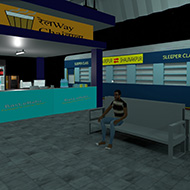
You crack the gas valve under Ramu’s counter, wait for the blue flicker to catch, and set the first pan of milk to heat while a loudspeaker somewhere down the platform announces a train that hasn’t shown up yet. That’s how every shift in Railway Chai Wala starts — not with a cutscene, but with your hands already busy. For the first stretch, the game plays exactly like its screenshots promise: brew chai, fry a samosa, hand a cold bottle of Kokila Cola to a tired traveler. Then the rhythm starts to feel off, and the game quietly becomes something else entirely.
| Genre |
Psychological horror thriller with cooking and simulation elements |
| Platform |
PC (Windows) |
| Core mechanic |
Serving passengers at a tea stall while a hidden mystery unfolds around it |
| Key names |
Ramu, Fakripur station, Kokila Cola |
| Length |
One continuous shift, no separate levels |
Learning the Rhythm of Ramu’s Counter
The first mistake almost everyone makes is treating the brewing loop like background busywork instead of the thing the game is actually testing. Milk needs a rolling boil before the tea leaves go in, the pan needs stirring at a pace nobody explains in a tutorial box, and a passenger left waiting too long grumbles and drifts toward another stall down the platform. None of this fails you outright at first, but it sets the tone fast: Ramu’s shop runs on attention, not reflexes.
Beginners also tend to rush the samosa station because it looks like the least important task on the counter. It isn’t. Passengers order snacks in clusters right before boarding calls, and missing that window means watching them walk off hungry, which changes how they talk to Ramu the next time they show up. Railway Chai Wala never spells this out — you learn it by losing a regular’s goodwill and noticing the difference next visit.
Roughly the first third of the game plays this way, and it’s worth resisting the urge to rush through just because you know a horror game is coming. The routine you build here — boil timing, greeting order, how fast you clear the counter between trains — becomes the baseline everything later gets measured against.
Controls Behind the Stall
Railway Chai Wala runs on a standard first-person scheme, and getting comfortable with it early pays off once the game starts asking you to react quickly.
- WASD to move Ramu around the stall and out onto the platform
- Left click to interact with whatever’s highlighted, from stirring the pan to handing over an order
- E to pick up or examine items on the counter
- Shift to sprint, useful once the station stops feeling entirely safe
There’s no combat and no inventory wheel to memorize, which fits a slow-burn story rather than an action title. That simplicity is a big part of why the game reads as approachable even to players who normally skip horror games — you’re never fighting the interface, only the growing unease at the station.
When the Platform Stops Feeling Normal
Players bring up one moment constantly: the first announcement for a train that never actually arrives. It’s easy to miss if you’re focused on the pan, but once you catch it, you start listening for it every time the loudspeaker crackles back on.
From there the wrongness builds gradually. A passenger repeats an order they already picked up. The far end of the platform dims a beat longer than it should. Railway Chai Wala prefers to let players sit with that discomfort rather than explain it through dialogue dumps, which is exactly the restraint fans of grounded indie horror tend to praise it for.
By the time you reach the point where Ramu is asked to close the stall for the night, the game has stopped being a simulation with horror garnish and become a slow reveal built entirely from details the ordinary opening shift trained you to notice.
The Regulars Who Keep Coming Back
Fakripur station isn’t filled with disposable extras. A handful of passengers return to the counter across the story, and each carries a small piece of the mystery without spelling it out. One regular always orders the same cup at the same sugar level, which makes the one time he changes it feel unmistakably significant. Another keeps asking about a train that doesn’t match anything on the platform boards.
Players who treat the counter like a real service job tend to greet every regular the same way each shift, and that habit is exactly what makes the deviations land. Completionist-minded players often go out of their way to talk to everyone before closing up, treating those conversations almost like a checklist rather than flavor text — and in community threads, people frequently describe Railway Chai Wala as closer to a walking sim with a job attached than a traditional horror title.
A third kind of player shows up too: the one mainly there for the scares, who admits in comment sections that they only started paying attention to dialogue after the second or third strange encounter. None of these approaches are exclusive, and most people drift between them across a single playthrough.
Details That Reward a Slower Shift
Most first playthroughs move too fast to catch the environmental storytelling scattered around the station. The condition of the tea leaves in Ramu’s tin shifts subtly as the shift goes on, and a few posters glued to the platform pillars are worth reading in full rather than skimming past.
None of this is required to finish, but players who skim tend to report the ending landing with less weight. The runtime usually sits well under two hours for a first pass, and that pacing is deliberate — a careful player and a rushed one walk away with noticeably different impressions of what happened at Fakripur station. One detail worth watching for: the way steam off the chai pan hangs in the air changes almost imperceptibly once the platform lighting shifts late, something you’d only notice after watching that same steam rise a hundred times during the mundane opening hour.
What Players Still Argue About
Not everything lands cleanly, and it’s worth saying so. The stretch right after the first strange incident, before the station fully tips into its darker register, drags for some players expecting faster escalation. Steam reviews for the game skew heavily positive, but even fans of Railway Chai Wala tend to single out that middle section as the point where patience gets tested.
There’s also a real split over how much the ending explains. Some players like that the game trusts them to piece the outcome together from shifting passenger behavior and environmental clues. Others want a firmer answer than the story is willing to give, and that disagreement shows up in nearly every discussion thread about how it ends.
What almost nobody disputes is the atmosphere. Even players frustrated with the pacing tend to admit the sound design — the specific hum of a station that’s a little too quiet — does most of the heavy lifting that makes the game memorable.
Is Railway Chai Wala a long game?
No. Most first playthroughs land under two hours, built around one continuous shift at Fakripur station rather than separate chapters. Players who slow down to read environmental details and talk to every regular land toward the longer end of that range.
Do choices affect the ending?
The story is largely linear, but how thoroughly you engage with regulars, including the one who always orders the same cup of chai, changes how complete certain late scenes feel. It’s less a branching system and more a matter of how much context you’ve built up by the time Ramu closes the stall.
Does the game rely on jump scares?
It leans on sustained unease rather than sudden shocks, closer to slow-burn anomaly horror than a scare-per-minute format. The tension comes from noticing that something at the station is wrong, not from loud stings.
By the time the last announcement plays over an empty platform and Ramu pulls the shutter down, Railway Chai Wala has stopped being about chai and samosas and become a game about paying attention. The regulars who never quite explained themselves, the schedule board that never matched what you heard — none of it resolves into a single tidy twist, and Fakripur station stays with you exactly because the game never tells you outright what you saw.