

BLOODMONEY!

Dead Plate

Elevator Hitch
Idle Breakout

LOVEMONEY!

My Buddy
Sort The Court: Royal Builder







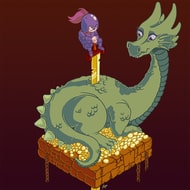














A single ominous event on the Day of Destiny threatens to wipe out every villager in Bunnyville, and Sephiria hands you nothing more than a sword, a shield, and a tower stretching downward beneath the town as your only way to stop it. What starts as a simple top-down brawler quickly reveals itself as a much deeper inventory puzzle once the first artifacts start dropping.
Sephiria structures its runs across six distinct chapters, each introducing new biomes and enemy types as you push deeper beneath Bunnyville. Rather than a single long descent, the chapter structure gives runs a clear rhythm, and reaching a new chapter for the first time is treated by the community almost like a milestone in its own right.
Sapphires, the game’s persistent currency, carry over between runs regardless of how deep a given attempt reaches, meaning even a failed descent still contributes toward permanent upgrades. This softens the sting of an early death considerably compared to roguelites where a bad run yields nothing at all.
The defining system in Sephiria is its strategic inventory: artifacts and tablets both occupy limited grid space, and how you physically arrange them relative to each other actually changes their combined effect. Tablets in particular can empower adjacent artifacts, turning inventory management into a spatial puzzle rather than a simple pick-everything-up loop.
New players consistently grab every artifact they find without considering placement, only to realize several chapters in that a more deliberate, tighter arrangement of fewer artifacts often outperforms a cluttered inventory. Community guides around Sephiria spend more time discussing grid layout than any single boss fight, which tells you where the real depth of the game sits.
Beyond the inventory puzzle, Sephiria offers six weapon branches with well over two hundred upgrades between them, letting a run built around, say, a fast dual-blade style feel completely different from one built around a heavier weapon branch. Talents unlocked between runs provide small permanent bonuses, gradually smoothing the difficulty curve for players willing to grind rather than reset from zero every time.
Online co-op supports up to four players working through the tower together, including trading items and reviving fallen teammates mid-run, and this cooperative structure is frequently cited as making Sephiria feel far less punishing than typical solo roguelites. Hard mode, on the other hand, is where opinions split; some players see it as the game’s real endgame test, while others feel it leans too heavily on enemy density rather than smarter enemy behavior.
Chapter difficulty spikes: the jump in enemy toughness between certain chapters is one of the more debated aspects of Sephiria, with some players calling specific transitions poorly telegraphed compared to the otherwise steady difficulty curve.
By the time a run either ends in a fallen Bunnyville or a hard-won descent to the tower’s depths, Sephiria has made its inventory puzzle the real star of the experience, artifacts and tablets included, and that grid-based decision-making is what keeps veteran players returning long after the six chapters have been cleared once already.
